

SEO: What does SEO mean?
Today, we’ll delve deeper into SEO (Search Engine Optimization). Think of it as the process by which we make our website appear at the top of the page in the eyes of search engines like Google.
Our goal is to ensure that when a user searches for something related to their needs, their website appears at the top.
When people come to your site directly from search results, without clicking on an ad, this is called organic traffic. In simple terms,
SEO means making your content so optimized, relevant, and valuable that both search engines and users believe it’s the answer they were looking for.
How Exactly Does SEO Work?
Students, to understand the workings of SEO, you need to understand three main steps. You can illustrate this with the example of a library:
Step 1: Crawling – Finding books in the library
Search engines, such as Google, constantly send small robots called “crawlers” or “spiders” across the internet.
These crawlers locate your website’s pages, read the content (text, images, videos), and also look at which other sites your website links to (links).
The first task of SEO is to ensure that crawlers can easily find their way to your website and don’t overlook any pages.
Step 2: Indexing
Once crawlers have collected information from your website, they will send this data to Google’s vast library, which is called the index.
Indexing your site means that Google has stored your site information and is now ready to display your website in Google search results.
This site’s results help to rank and display your website to the required user, which helps to gain more clicks and trust in the website.
In SEO, we keep our content clear, well-defined, and structured so that Google understands the topic of your page very well. If Google has difficulty understanding the topic, it won’t display it in the right search results.
Step 3: Ranking
When a user searches for something on Google (i.e., types in a keyword). Google looks at its index to see which websites are most useful and relevant to that search, depending on the search queries.
This is where the work of SEO comes in. Google uses hundreds of ranking factors (such as site speed, authority, keyword usage, user experience, etc.) to determine whether your website should rank number 1 or number 10.
The website that performs best on all these factors receives a higher ranking. The ultimate goal of our SEO is to surpass our competitors and reach the top, so that more users find us and visit our site.
Remember, SEO is not a one-time task. It is a continuous process, which means your content should be improved. And with the great quality information you site, you can have a good ranking since Google’s rules and user needs are always changing.
What are the four types of SEO?
SEO is a vast field, but we can broadly divide it into four main areas. These four areas tell us where we need to work to optimize our website. These four areas are essentially the same core components of SEO as we discussed earlier, but now we’ll understand them as types:
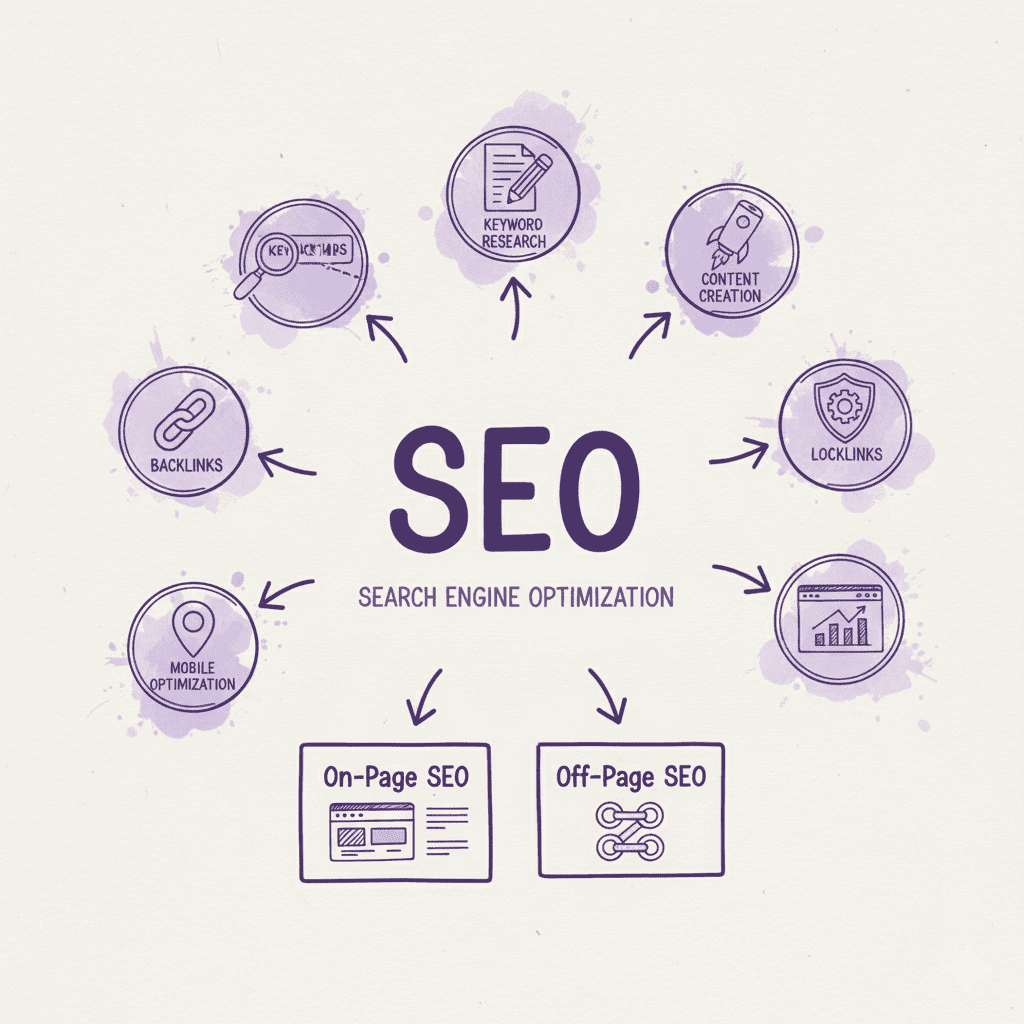
On-Page SEO
On-page SEO refers to everything we do within our website, directly on a webpage. Think of it like writing your homework clearly and concisely. We ensure that our page titles are clear, headings (H1, H2) are in the right place, our key keywords are used correctly in the content, and images are optimized. All of this directly tells search engines what your page is about and how relevant it is to users.
Off-Page SEO
Off-page SEO refers to activities that occur outside of your website but affect your ranking. You can think of it like building a good reputation in your niche. When another trusted and popular website provides you with a backlink (i.e., links to you), Google considers it a recommendation. If you receive more positive recommendations, your website’s authority and trustworthiness will increase. This will result in improving your ranking in search engines.
Technical SEO
Technical SEO deals with the technical aspects of a website. It means it is directly related to search engine crawlers. Think of it like maintaining your car’s engine. We consider the site’s loading speed, its mobile-friendliness, whether crawlers can crawl your entire site without interruption, and whether your website’s structure is correct. All of this ensures that search engines can easily find your site and index your site.
Local SEO
Local SEO is most important for your businesses that serve customers within a geographic area(in your area), such as a restaurant, a doctor, or a beauty parlor. When a user searches for “[service/product] near me” or “[service/product] in Delhi,” your shop or office appears in search results with Google Maps. To do this, we need to optimize Google My Business (GMB) and ensure the local name, address, and phone number (NAP) are accurate.
What is SEO an example of?
SEO is primarily a very important example of digital marketing, but it also falls under a specific type of marketing called inbound marketing.
Example of Digital Marketing
SEO is a digital marketing strategy. Digital marketing is marketing that uses the internet and digital technologies.
It’s a way to promote your business and reach customers using online mediums (such as websites, search engines).
Key Example of Inbound Marketing
Most accurately, SEO is a prime example of inbound marketing.
In inbound marketing, we don’t interrupt customers with forced ads (like on TV or banners). Instead, we create valuable content that customers find themselves searching for.
SEO works on this principle: you create great content, get it ranked on Google, and when users need it, they automatically find your website.
So, in short, SEO is a powerful inbound marketing technique that falls under the umbrella of digital marketing.
To do SEO for a website or to rank a blog or a site, it takes time. You have to put continuous effort and good quality content for your website to rank. If your website is new, it can take up to three to six months at the beginning. At this early stage, even a small improvement in keyword rankings can boost your organic traffic (visitors coming from search engines). If you’ve chosen a highly competitive niche or your site is brand new, it may take six to twelve months, or even longer, to see significant and lasting results. This is primarily because Google needs time to build your website’s authority and understand why your content is better than other websites.
What factors influence this timeframe?
Several important factors influence this SEO timeline, which are important to understand:
Your website’s age and current status:
New website: New websites take longer to gain trust in Google’s index because they lack domain authority. Domain authority is an SEO metric that estimates a website’s likelihood of ranking in search results on a scale of 1 to 100. The domain authority of a website increases through high-quality backlinks, content quality, and other SEO signals. Although domain authority is not a direct Google ranking factor. It helps to understand your website’s competitors and also tracks the SEO progress.
But if your website is older and already has some authority, then it is somewhat easy for your content and blog to rank your site.
Competition level:
Keyword competitions also play a vital role in the ranking of your site. For example, if a user searches for a keyword, and on that keyword, there is no other site content. Then your site can rank first.
So, if you’re working on low-competition keywords, there is a much higher chance of ranking faster in just a few weeks.
But if you want to rank for keywords that big brands and established websites are competing for, it’s a long battle that will require more time, resources, and effort.
The Quality of Your SEO Strategy:
The seo strategy can be different for different sites. You can analyze their seo strategy and, by using some SEO tools, if you start writing good quality content, then it is very easy to rank. Just by making a few on-page changes in your site, you will start seeing the result.
You can also build off-page authority(backlinks), and fix your technical issues and site speed, and then your results can improve.
In short, to succeed, you need constant improvements in your content and blogs. You have to be patient for results. Only with the right strategy and consistent effort can you achieve top rankings in search results.
Is SEO a high-paying job?
Children, SEO is an excellent career choice in the current digital age because almost every business that exists online needs SEO experts to increase its visibility. In today’s world, if a website or its content or blog doesn’t appear on search engines, it is very hard for that business to survive in the long run. It will miss the chance of getting more customers and more reaches. Therefore, the demand for SEO professionals is constantly increasing. It’s a skill that combines technical knowledge with creative thinking and data analysis. This job is always interesting and challenging. The best part about this career is that there are endless opportunities for learning and growth; you’re always keeping up with Google’s latest updates and trends.
Career Growth and Earning Potential
SEO offers you a variety of career paths. You can work as an in-house SEO specialist at a large company, serve various clients for a digital marketing agency, or become an entrepreneur by starting as a freelancer or building your own websites. All of these paths offer good salary packages and rapid career growth potential, as it’s a skill that directly impacts a company’s revenue. It’s a highly future-oriented and secure career option for students interested in the world of the internet, data, and technology.
What is an SEO salary?
The great thing about an SEO career is that your earnings increase rapidly as your experience increases. For an entry-level SEO executive with 0-2 years of experience, the salary starts with a starting package of ₹2.5 lakh to ₹4.5 lakh per year. After two to five years of gaining experience in this field, when you become an SEO specialist or strategist, this range increases to ₹4.5 lakh to ₹8.5 lakh per year. The highest earnings are at the senior-level with 5+ years of experience, an SEO manager or director can easily earn ₹12 lakh to ₹25 lakh per year or even more. An SEO manager can lead large teams and can directly manage the company’s digital strategy.
Other Earnings
SEO professionals have many other sources of income. Many experts venture into freelancing, where they charge on an hourly or per-project basis. An experienced SEO freelancer, especially one working with international clients, can earn more than a job. Furthermore, professionals specializing in specific areas, such as technical SEO or content strategy, always charge a premium. Students who start their own websites (affiliate blogs or e-commerce) and make them successful through SEO also create a great source of passive income, which can multiply their monthly earnings. This career offers a good salary but also a path to financial freedom.